ABOUT CERN
CERN, the European Organization for Nuclear Research, was founded in 1954.
As the world’s leading laboratory for high-energy particle physics, its core mission is fundamental physics research, aiming to answer questions about the fundamental constituents of matters and the Universe’s structure and evolution.
A LABORATORY FOR THE WORLD
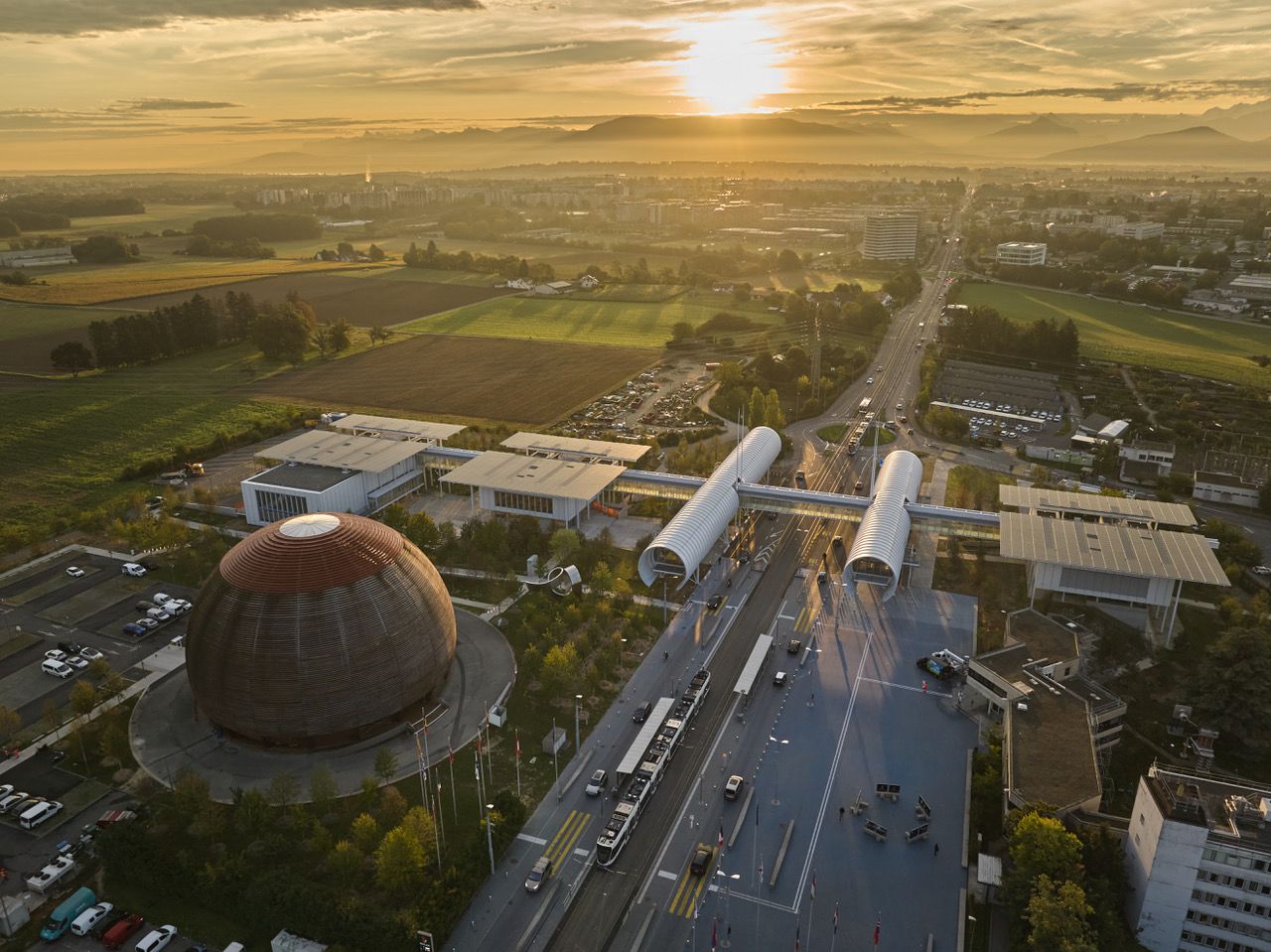
CERN is an intergovernmental organisation whose headquarters are in Meyrin, in the Swiss canton of Geneva.
CERN’s various facilities span both its Host States, Switzerland and France, and feature two main campuses: the original site in Meyrin, which straddles the Swiss-French border, and another in Prévessin, France.
The collaborative spirit between nations, institutions and scientists drives CERN’s research. With over 17 000 contributors worldwide representing more than 110 nationalities, CERN benefits from a diverse network of talent. These contributors include approximately 3 700 CERN employees working on the design, construction and operation of the research infrastructure, collaborating with a vast user community of over 12 400 scientists from institutions in more than 80 countries. Aligned with the principles of open science, CERN ensures that its research and technology outcomes are publicly accessible to society worldwide.
CERN’s work significantly contributes to several United Nations Sustainable Development Goals (SDGs), in particular those relating to good health and well-being (3), quality education (4), gender equality (5), affordable and clean energy (7), industry, innovation and infrastructure (9), peace, justice and strong institutions (16), and partnerships for the goals (17). The Organization actively contributes to their implementation and aligns its environmental impact reduction efforts with additional SDGs (see GRI Content Index).
GOVERNANCE AND GLOBAL COLLABORATION
CERN’s family grew in the reporting period, with Brazil joining as an Associate Member State in 2023 and Estonia as a Member State in 2024. At the end of 2024, the Organization has 24 Member States, ten Associate Member States and four Observers. Following decisions by the Council in 2022, the Organization’s cooperation with the Russian Federation and the Republic of Belarus terminated upon the expiry of the International Cooperation Agreements (ICAs) with the two countries in 2024.
The CERN Council, as the Organization’s highest authority, oversees the strategy pursued in scientific, technical, administrative and other matters. Each Member State has a single vote, with most decisions requiring a simple majority. The Council is supported by five subordinate bodies: the Scientific Policy Committee, the Finance Committee, the Audit Committee, the Tripartite Employment Conditions Forum and the Pension Fund Governing Board.
Appointed by the Council, usually for five years, the CERN Director-General manages the Organization and reports directly to the Council. The Director-General is assisted by a Directorate composed of members proposed by the Director-General and appointed by the Council. In addition, CERN has an Enlarged Directorate, which consists of all the Directors and Department Heads.
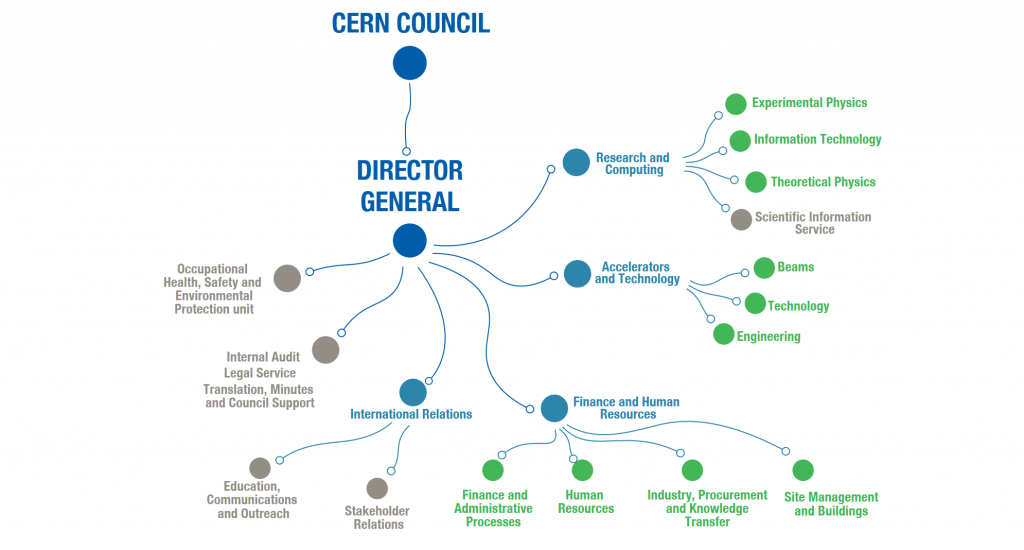
The Staff Association is the only statutory organ representing the entire personnel, notably at the Tripartite Employment Conditions Forum (TREF). Besides the Staff Association, TREF is composed of representatives of the Member States and the Management, and its role is to examine the conditions of pay and employment.
The Organization is prominent on the global research stage, collaborating with national and international institutions and represented on scientific bodies such as the International and European Committees for Future Accelerators (ICFA and ECFA). CERN is a member of the European Intergovernmental Research Organisation forum (EIROForum), which connects Europe’s major scientific research institutions, allowing exchanges on environmental initiatives and various other topics through dedicated working groups. CERN also holds Observer status at the United Nations General Assembly, underscoring its commitment to global scientific cooperation.
ETHICS AND INTEGRITY
CERN’s commitment to research, innovation, education and collaboration is built on strong ethical standards. The CERN Staff Rules and Regulations outline the responsibilities of the Organization and its personnel. CERN’s Code of Conduct embodies the Organization’s values, namely integrity, commitment, professionalism, creativity and diversity and applies to everyone on CERN’s sites, ensuring a respectful and supportive working environment.
CERN is committed to engagement with its personnel, whether they are employed by the Organization or come to the Laboratory to carry out their research. To this end, several mechanisms for engagement, feedback, support and reconciliation are in place, notably through the Ombud, the Human Resources department, the Users Office and the Staff Association, and dedicated bodies are in place to address specific concerns.
UNIQUE INSTALLATIONS FOR UNIQUE RESEARCH
CERN’s particle accelerators enable frontier research in particle physics. The Large Hardon Collider, or LHC, CERN’s current flagship facility, is the world’s largest and most powerful accelerator, colliding proton and heavy ion beams in several particle detectors for study by scientists. The LHC’s capabilities will be further expanded with the High-Luminosity LHC (HL-LHC), which is expected to operate from 2030 to 2041 with the aim of increasing the beam collision rate (luminosity) and consequently boosting the amount of physics data that can be collected, allowing further measurements, observations and possibly discoveries to be made.
Planning for a successor to the HL-LHC is a priority for the Organization, along with R&D on various technologies in preparation for potential future facilities to extend CERN’s research vision into the late 21st century. In 2021, responding to a recommendation from the 2020 update of the European Strategy for Particle Physics (ESPP) to “investigate the technical and financial feasibility of a future hadron collider at CERN with a centre-of-mass energy of at least 100 TeV and with an electron-positron Higgs and electroweak factory as a possible first stage”, the CERN Council launched the Future Circular Collider Feasibility Study to examine the detailed implementation of such a venture. The mid-term review of this study, which evaluated the project’s technological, geological, environmental, administrative, financial and territorial feasibility, was concluded in February 2024. The mid-term review generated positive conclusions, along with high expectations as to final results of the study, which are due to be released in 2025 as input for the ESPP update.
INSPIRING AND EDUCATING NEW GENERATIONS
Education is at the heart of CERN’s mission, with its research and technology inspiring students and the public alike. The Laboratory has long been a popular destination, welcoming hundreds of thousands of visitors each year on guided tours. This reach expanded significantly with the opening of the CERN Science Gateway, a dedicated centre for education and outreach, inaugurated on 7 October 2023. By the end of 2024, it had welcomed over 450 000 visitors from more than 175 countries — a marked rise from the pre-opening annual average of around 150 000.
Each year, several thousand students take part in CERN’s training and graduate programmes, while many more engage with the Laboratory through a wide range of educational initiatives, from undergraduate internships to high-school competitions, primary school activities, and specialised training for high-school teachers.
ENGAGING WITH THE CERN COMMUNITY
CERN’s Management is dedicated to environmentally responsible research practices and engages regularly with its personnel in order to foster the unique creative and innovative spirit that characterises the Organization for the benefit of the environment (see Knowledge and Technology for the Environment). Following a successful workshop in 2022 to inform the CERN community of the many actions and projects under way to address the Organization’s environmental priorities and objectives, a Town Hall meeting was organised on CERN and the environment in November 2024 to provide an update and to introduce the new and expanded objectives for the period until 2030 (see Management Approach).