

ENVIRONMENTAL COMPLIANCE AND MANAGEMENT OF HAZARDOUS SUBSTANCES
In accordance with its intergovernmental status, CERN establishes its own regulatory framework as necessary for its functioning, including in matters of safety. This framework covers all activities and sites and takes into account Host States’ and EU regulations, as well as international standards. CERN is committed to limiting its impact on the environment and implements an extensive array of measures to this end, including environmental monitoring.
PREVENTING CONVENTIONAL ENVIRONMENTAL ACCIDENTS
CERN’s Safety Policy encompasses all aspects of safety, including occupational health and safety, radiation protection, the protection of the environment and the safe operation of CERN’s installations, including radiation safety. Adequate measures for preventing environmental accidents, environmental events and near misses, along with remedial actions, fall under the responsibility of the departments concerned. Their follow-up is overseen by the CERN Environmental Protection Steering Board (CEPS – see Management Approach).
To keep the impact of CERN’s activities on the environment to the minimum, an extensive environmental monitoring programme spanning both radiological and physicochemical parameters is implemented by the Occupational Health and Safety and Environmental Protection unit. In the event of an anomaly or accidental chemical release, dedicated procedures involving trained teams are in place to guarantee a prompt response in order to stop and limit the impact.
CERN has defined a clear framework for classifying events according to their potential impact. It has also implemented a robust procedure for communication and follow-up with the local authorities.
During the period covered by this report, a significant water leak was reported and duly resolved (see Water and Effluents), but no event occurred that would have led to a fine or a non-monetary sanction.

PREVENTING RADIOLOGICAL ENVIRONMENTAL ACCIDENTS
CERN has robust radiation safety and radiation protection rules in place (see Ionising Radiation). No environmental radiological accident has ever occurred on the CERN site.

MANAGING HAZARDOUS SUBSTANCES
CERN’s regulatory framework for hazardous substances addresses potential risks to soil and water and is continuously adapted in line with the relevant Host State regulations. These substances are subject to regular monitoring and reporting. The CERN Chemical Register for Environment, Health and Safety (CERES) is a web-based tool for tracking chemicals at CERN and identifying the associated risks and their locations. This in turn allows the preventive measures in place to be adjusted to mitigate risk and operational measures to be designed to handle potential incidents.
The tool is continuously updated by users and features an in-built system for checking the reliability of their entries. Depending on the quantity and type of the product, an environmental risk analysis may be required that takes into account a specific set of criteria as well as all CERN infrastructure considerations, such as the presence of water retention basins at site boundaries. These features also help to identify buildings with potential activities involving hazardous substances that entail specific technical requirements based on quantity, toxicity and substance type, and generally require priorities and action plans to be defined. At the end of 2024, the register comprised more than 3 000 validated entries, of which some 1 400 had recently been checked by the users, and just over 850 were subject to an environmental risk analysis.
One of the priorities is reducing the quantity of mineral oil present on the CERN site in transformers. In this context, a project to replace oil transformers by oil-free alternatives was launched in 2021. It targets more than 100 transformers over a period of ten years. Over the reporting period and up to March 2025, more than 25 will have been replaced and a further 20 eliminated, resulting in the removal of more than some 100 m3 (approximately 80 tonnes) of mineral oil. This project also includes the clean-up of the transformer retention pits, which are filled with pebbles exhibiting varying degrees of oil concentration.
In 2024, CERN conducted a sustainability analysis that included technical, logistical, economic, operational and environmental aspects to identify the most effective solution for ensuring the treatment and recovery of these pebbles in alignment with European and local directives on waste management. Various options were tested in collaboration with suppliers, including on-site washing and storage, reinforcing CERN’s role as a testing ground for optimising recycling and waste management practices. After assessing the environmental impact and the site constraints, it was established that sending the pebbles to a local specialised waste management contractor for treatment and recycling would be the most effective approach. This solution prioritises reuse over landfill, repurposing the material for applications such as cement production and road surfacing.
Radioactive materials are a unique category of hazardous substance and are strictly regulated throughout their lifecycle, including with respect to use, handling and transport. Radiological risk assessments are conducted before handling, and users undergo comprehensive radiation protection training to be able to assess radiological risks and apply the related radiation protection rules and procedures. The transport of such materials both on and off the CERN site is closely monitored, with public road transport conforming to ADR (European Agreement concerning the International Carriage of Dangerous Goods by Road) regulations.
GOALS FOR 2030
During the period until 2030, CERN’s objective is to reduce the potential environmental impact of hazardous substances used for the Organization’s activities. Concretely, the aim is to reduce the quantity of transformer oil present on the CERN sites by 120 m3 (compared to the 2023 baseline, 1784 m3).
IN FOCUS
Sabrina Schadegg leads the Environmental Prevention section of the CERN Environment group. She is a member of the HSE Operational Response (HOR) project, which was launched in 2022 by CERN’s Occupational Health and Safety and Environmental protection (HSE) unit to clarify and refine the operational response capabilities of all HSE unit services in collaboration with teams across the Organization.
— How has the HOR project helped to refine cross-team collaboration, notably with the CERN Fire and Rescue Service?
SS: One of the project’s six work packages is dedicated to the appropriate response to emergencies affecting the environment and the Organization’s assetswhich aims to future-proof CERN’s ability to protect the environment in the event of a significant environmental event, such as a chemical spill, fire or any other unforeseen environmental incident.
Thanks to the actions of the PoLiChem (Prevention of Pollution by Liquid Chemical Agents) working group—which ran from 2015 to 2018 to recommend actions, monitored by the CEPS, to reduce pollution risks—and to the subsequent implementation of the CERES tool, CERN has markedly improved its approach to preventing environmental incidents. Some of CERN’s facilities are quite dated and small-scale environmental incidents can occur given that collective retention measures, such as centralised retention basins upstream of water outlets into rivers, were not systematically integrated in the original designs.
— What were the key challenges in updating the existing response protocol, and how was it tested?
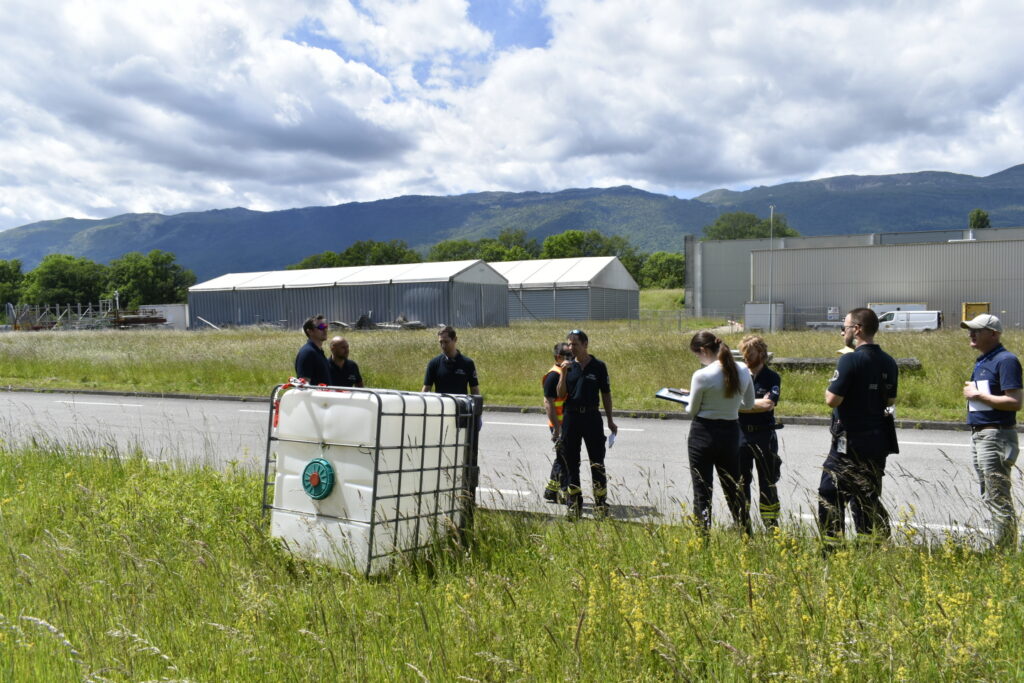
SS: The biggest challenge was creating a procedure that was comprehensive yet simple enough for the intervention teams. It needed to cover the highest possible percentage of predictable incidents, ideally up to 90%, while allowing flexibility in the event of unforeseen situations. The new protocol was developed over two years and tested in a large-scale exercise in summer 2024. This exercise highlighted the strengths and provided valuable insights for further improvement. Importantly, it fostered strong relationships between CFRS, the environment team, the CERN Control Centre operators—who oversee the technical infrastructure— and colleagues responsible for the equipment, thereby ensuring seamless collaboration in real emergencies. The protocol sets a clear benchmark for integrated operational response systems for use in case of environmental events.