
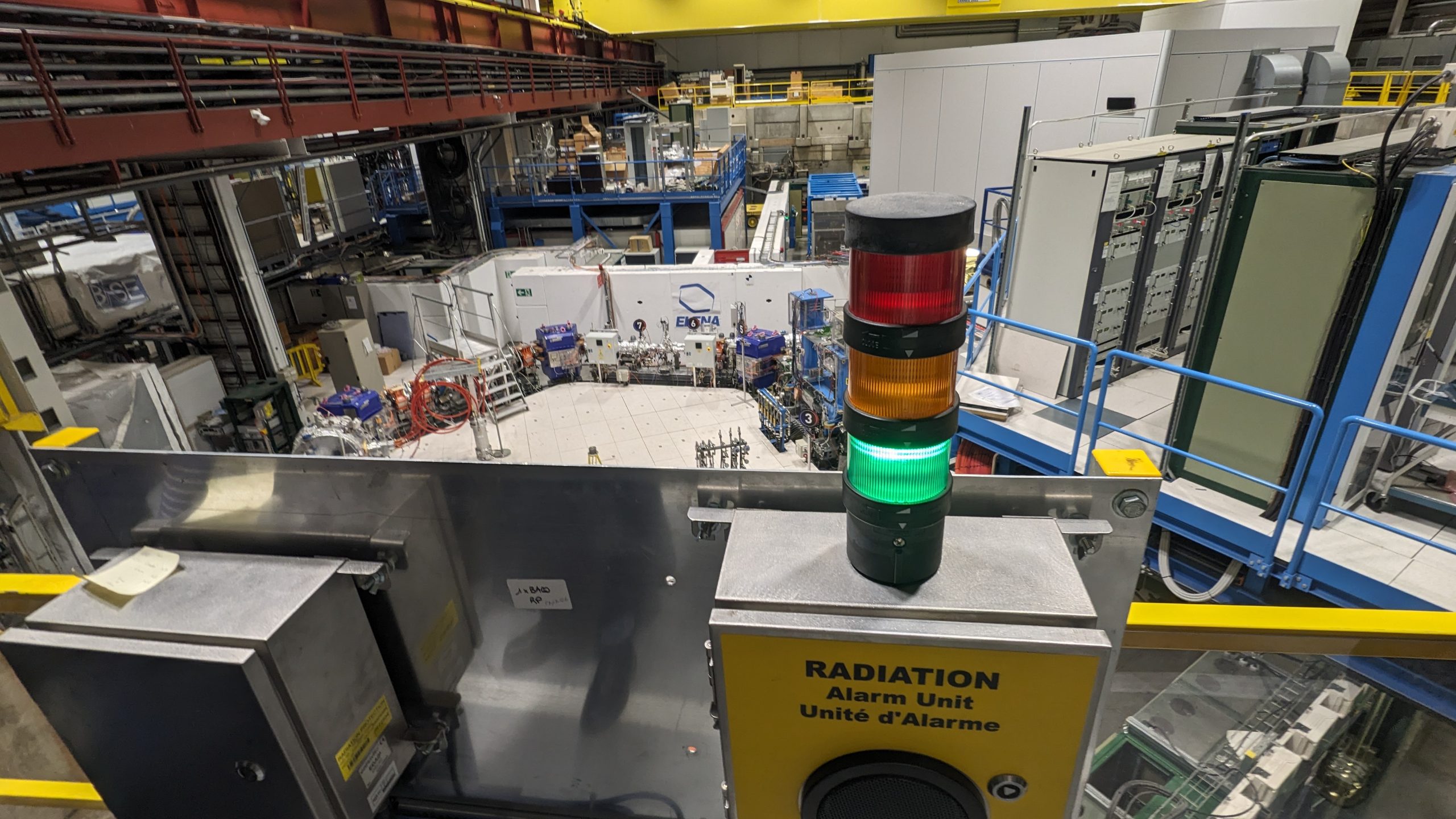
IONISING RADIATION
At CERN, ionising radiation is produced by the collisions of particle beams with matter. It is also produced by radioactive sources that are used to test and calibrate equipment to ensure its safe operation. CERN’s commitment to the continuous improvement of its procedures and systems in order to minimise the exposure of workers, the public and the environment makes the Organization a benchmark in the field.
MANAGING IONISING RADIATION AT CERN
CERN implements internationally recognised radiation protection and radiation safety systems and also contributes to their development. The Organization continuously improves procedures to minimise the risk of radiation exposure and the dissemination of radioactive material. In particular, it adheres to the internationally recognised As Low As Reasonably Achievable (ALARA) principle, which is applied from the design and operation of installations through to their dismantling.
CERN’s legal framework for radiation protection covers the protection of CERN personnel, the public and the environment and is based on Host State legislation, as well as on applicable European and international standards and best practice in matters of radiation protection and radiation safety. A tripartite agreement between CERN and its Host States has been in force since 2010, providing the legal framework for the discussion of CERN-wide radiation safety and radiation protection matters in a transparent and collaborative way (see Management Approach). In this context, CERN issues quarterly environmental monitoring reports spanning both radiological and physicochemical aspects to the Swiss and French authorities.
| What is ionising radiation? Ionising radiation is a natural phenomenon. It comes from certain minerals in the earth, from space through cosmic rays or from UV radiation. However, it can also be produced artificially for medical or diagnostic purposes such as X-Rays. Industrial and research facilities can also generate and use ionising radiation. All humans are naturally exposed to, and receive daily, small doses of ionising radiation due to these natural and human-made sources. The limits for exposure to ionising radiation are defined by regulations, which are based on the consideration that health risks increase in direct proportion to exposure. Evidence suggests that cells can repair radiation damage at low doses. Over a normal year, we receive a dose of about 3 mSv from radiation of natural origin. Some activities, such as flying, smoking and medical X-rays result in an increased dose. |
MONITORING AND PREDICTING
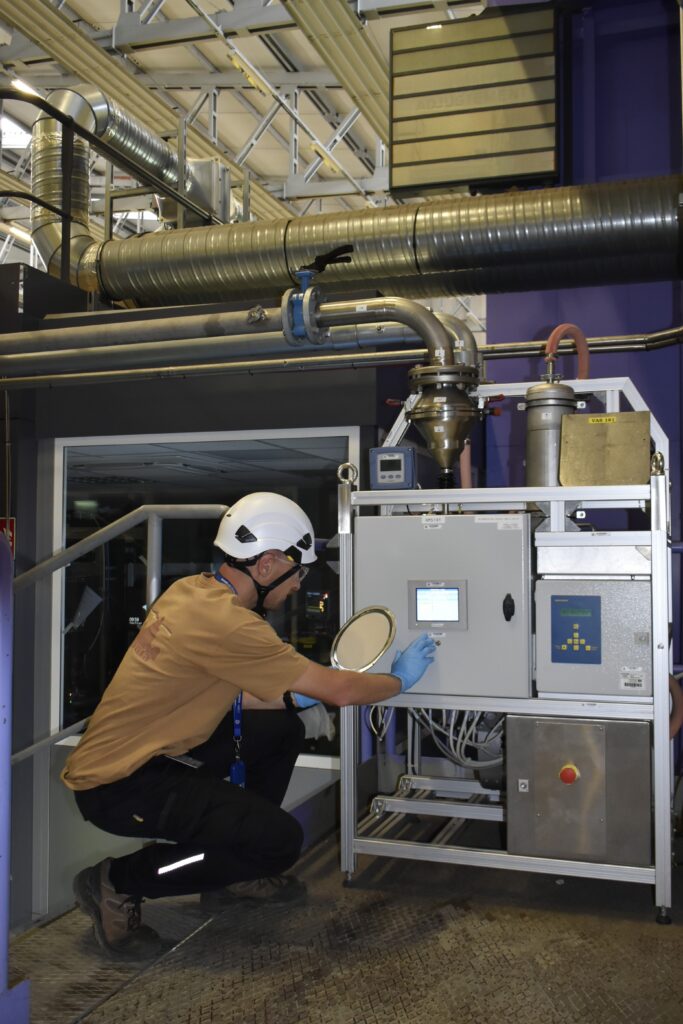
The Laboratory operates an extensive network of environmental radiation monitors and online sampling systems. In 2024, the environmental monitoring programme comprised 131 monitoring stations for various purposes, 35 of which are dedicated to stray radiation, 60 to ventilation and radiological monitoring of water, 16 to physicochemical monitoring and the remainder to aerosol sampling and weather monitoring. The monitoring programme is supplemented by use of thermoluminescent dosimeters and measurement of environmental samples.
The environmental monitoring infrastructure is part of CERN’s automated control and safety systems. The Radiation and Environmental Monitoring Unified System (REMUS) allows operators to view radiation levels in real time across the site and receive alerts if any abnormalities are detected.
CERN’s models to evaluate the doses that members of the public could potentially receive are based on widely recognised models and standards, despite the specific nature of CERN’s facilities. In April 2023, these models were reviewed and endorsed by the Host State authorities. The endorsed models are now used in all assessments of CERN’s radiological environmental impact, including both retrospective evaluations of current operations and prospective impact studies for future projects.
Furthermore, the Swiss Federal Office for Public Health (FOPH) and the French Autorité de sûreté nucléaire et de radioprotection (ASNR, formerly ASN) place their own monitoring devices on the CERN site to monitor stray radiation and environmental radioactivity inside and outside the CERN perimeter. This contributes to broader annual measuring campaigns beyond CERN’s borders, both in Switzerland and in France.
MINIMAL RADIOLOGICAL IMPACT
The radiological impact of CERN on the public is very small. In 2024, the dose received by any member of the public living near the Laboratory was below 0.01 millisievert (mSv), over one hundred times lower than the Host States’ limit for public exposure from all regulated sources, which is 1 mSv in a year.
At CERN, all workers who could potentially be exposed to ionising radiation (radiation workers) are provided with personal dosimeters to monitor their exposure. Exposure frequency varies concomitantly with machine operation and shutdown periods. CERN’s provisions and measures ensure that the Organization stays well below the regulatory limits of 6 mSv for category B radiation workers and 20 mSv for category A radiation workers, as defined by Swiss and EU regulations. The majority of radiation workers register a null dose (0 mSv).
GOALS FOR 2030
Despite an expanding physics programme, CERN’s objective in the period until 2030 is to keep its radiological environmental impact negligible by continually optimising its facilities and activities to ensure that doses potentially received by the public are kept below 0.02 mSv per year.
IN FOCUS
Angela Goehring-Crinon is the legal adviser for the HSE unit and the person responsible for links with the radiation protection and radiation safety authorities in the Host States. Stefan Roesler is the Head of the CERN Radiation Protection group. Both share their perspectives on the impact of the tripartite agreement on radiation protection and radiation safety, which was signed in 2010.
— 15 years after its signature, how has the tripartite agreement shaped CERN’s approach to the regulatory framework regarding radiation protection and radiation safety at CERN?
AGC: The tripartite agreement creates a unified legal framework to discuss how the common objective of protecting people working on the CERN site and the public against ionising radiation can best be achieved in the context of CERN’s activities.
Keeping CERN in line with standard best practice in the Host States and in Europe whilst taking the Organization’s specific technical and organisational characteristics into account is a challenge that is addressed through an open and constructive dialogue between the parties. An example of this collaboration is the development of an original classification method for transporting CERN’s radioactive materials, which ensures compliance with the agreement concerning the international carriage of dangerous goods by road (ADR) transport procedures in its unique cross-border context. The Host States also facilitate CERN’s functioning by recognising authorisations issued by the other country and by allowing CERN to eliminate its radioactive waste through the most suitable pathway in either country, in line with the fair share principle (see Waste).
— From a technical perspective, how has the tripartite agreement influenced the development and implementation of radiation protection measures?
SR: The tripartite agreement ensures uniform radiation protection measures across all CERN installations, regardless of their location. It covers the entire lifecycle of a facility, from its design to operational radiation protection practices and radioactive waste management.
A good example is the simplified clearance method for components from radiation areas with negligible activation risks. The method was developed in house and approved by the Host States. It enables rapid radiological classification of components that are removed during shutdowns, which is essential for CERN’s efficient functioning, while ensuring that radiation protection requirements are met.
The agreement has also made it possible to streamline radioactive waste management, centralising treatment before disposal at CERN’s dedicated facility and leveraging Host State infrastructure for sustainable waste elimination.
Finally, worthy of mention is the method developed for assessing CERN’s radiological impact on the public and the environment which has been agreed with the Host State authorities. It is tailor-made to allow CERN’s emissions to be monitored in its particular context.