KNOWLEDGE AND TECHNOLOGY FOR THE ENVIRONMENT
In pushing back the boundaries of science, CERN actively engages in the identification and development of technologies that can benefit society. This is achieved through innovation in environmental applications, in collaboration with academia and industry, and also by making the campus available to institutes and research consortia as a testbed for sustainable solutions.
PARTNERSHIPS FOR ENVIRONMENTAL INNOVATION
The driving force behind CERN’s technology transfer activities is a thriving and growing partnership with industrial, academic and research institutes across five focus areas, including the environment.
The CERN Innovation Programme on Environmental Applications (CIPEA) was launched in 2022 as a call for ideas from the CERN community to stimulate environmental application innovation based on CERN’s technologies, know-how and facilities. The programme was expanded in 2023-2024 to include projects selected in collaboration with external partners, mainly from industry, in the key areas identified during the process of drawing up the 2022 strategy. The eight CERN community projects initially selected are generating the first results. Together with the new projects defined in collaboration with industry, this brings the total number of projects at an advanced level of maturity to 25 today. 80% of the funding for the CIPEA programme is external, mostly coming from industrial partners in the Member States. The projects under way focus on four key areas: low-carbon energy; clean transportation and future mobility; climate change and pollution control; and sustainability and green science.
RENEWABLE AND LOW-CARBON ENERGY
Many CERN technologies can be applied in the emerging field of fusion energy, which has the potential to become a reliable and sustainable low-carbon alternative to fossil fuels and nuclear fission that generates no greenhouse gases (GHG) and minimal radioactive waste. CERN collaborates with several industrial partners such as Rolf Kind GmbH, a German steel manufacturer, to test the capability of advanced stainless-steel forgings to withstand extreme loads at cryogenic temperatures in future fusion plants. Further, CERN has established long-term strategic partnerships with public and private entities, such as EUROfusion, Gauss Fusion and Eni, to look for synergies between fusion energy and particle accelerator technologies, including in the fields of muon collider development and high-temperature superconductors.
In 2023, CERN signed a partnership with SuperNode in Ireland with the goal of enhancing energy transmission technology essential for integrating renewable energy sources. Leveraging its expertise in vacuum systems, CERN is assisting SuperNode in developing advanced cryostats to ensure the thermal insulation of their superconducting cables. These cables are designed to transfer bulk electricity, produced for instance by off-shore wind farms, over vast distances—including across the oceans—with minimal electrical losses and maintenance needs.
CLEAN TRANSPORTATION AND FUTURE MOBILITY
Transport is one of the fastest-growing sources of GHG emissions, and CERN’s technology transfer efforts aim to find cleaner, safer and more efficient mobility solutions in the aviation, shipping, rail and automotive fields.
A specific example concerns the development of technologies for the maritime transport of liquid hydrogen from producers to customers across the world, thus fostering a sustainable hydrogen economy. Hydrogen is a particularly promising energy source as it generates no GHG emissions and allows large-scale energy storage. For efficient transport and storage, hydrogen must be cooled to liquid form, at -253℃, placing challenging thermal design requirements on the on-board tanks. Ensuring minimal leakage is also critical for safety, as hydrogen is very volatile and flammable. In this context, CERN is collaborating with Gaztransport & Technigaz (GTT) to develop large liquid hydrogen (LH2) storage tanks for maritime transport. The project focuses on adapting liquefied natural gas (LNG) carrier designs for LH2 by optimising materials specifications, welding procedures for leak tightness and vacuum insulation layer materials.
Launched in 2022, a partnership between CERN and the Airbus subsidiary UpNext explores the use of CERN’s superconducting technologies in future low-emission aircraft. A key milestone was reached in 2023 with the successful development, construction and testing at CERN of SCALE (“Super-Conductors for Aviation with Low Emissions”), a one-off demonstrator for a superconducting powertrain transmission line.
CLIMATE CHANGE AND POLLUTION CONTROL
CERN’s expertise and technologies contribute to advances in environmental modelling and monitoring through Earth observation. These processes play an essential role in assessing pollution, managing resources and responding to natural disasters.
CERN is contributing with its machine learning know-how to EMP2 (Environmental and Modelling Prediction), a groundbreaking project being carried out in collaboration with Forschungszentrum Jülich (Germany) and the ECMWF (European Centre for Medium-Range Weather Forecasts) to develop an AI-powered digital twin for atmospheric dynamics. Trained on 40 years of hourly data from Copernicus, the tool improves weather predictions through precise “nowcasting” (forecasts for up to six hours), enhanced resolution of extreme weather phenomena (downscaling from 32 km to 6 km) and correction of precipitation biases. Leveraging open source software like ATMOREP, this innovative approach enables very fast and robust predictions of extreme events and outperforms traditional numerical weather models. The EMP2 model will be used in the ambitious EU-funded WeatherGenerator project, with the goal of combining all data sources in a general model for multiple tasks. It will also be used in the framework of the recently signed partnership between CERN and the World Food Programme to forecast seasonal crop production and address world hunger issues.
Edge SpAIce, funded by the EU, is a collaboration between CERN, EnduroSat in Bulgaria, NTU Athens in Greece and AGENIUM Space in France. The project leverages CERN’s cutting-edge AI technology to monitor the Earth’s ecosystems from space in order to detect and track plastic pollution in our oceans. Its aim is to develop a dedicated on-board system for satellites that will make it possible to acquire and process high-resolution pictures using a DNN (Deep Neural Network). The system uses the Edge AI approach, in which data is processed in near real-time directly on the satellite, mirroring the efficient filtering of LHC data in particle detectors at CERN.
The UTMOST CLEEN project focuses on enabling exhaust gas purification for hard-to-abate sectors like shipping and the semiconductor industry by developing compact and durable electron beam flue gas treatment (EBFGT) technology to reduce noxious gas (SOx and NOx) emissions from transportation and industrial sources. This innovative technology can reduce SOx emissions by up to 95% and NOx emissions by up to 80%, significantly cutting harmful emissions.
Sustainability and green science
The MotorSense project is a collaboration between CERN and ABB that leverages smart sensors and digital twins to optimise energy use in cooling and ventilation systems. Since its start in 2022, over 100 smart sensors have been installed on more than 800 low-voltage motors to monitor output power, speed, vibration and operating efficiency. Enhanced sensor algorithms and digital twins provide data-driven recommendations for energy savings, identifying opportunities to reduce electricity consumption by 17.4% (up to 31 GWh annually). This innovative approach is scalable to other infrastructures with similar cooling and ventilation requirements.
In the context of minimising its GHG emissions, an area of focus for CERN is the search for suitable alternatives to the GHG gases it uses in various applications, notably SF6 for detector cooling and particle detection (see Emissions). SF6, a greenhouse gas with a very high global warming potential, is also used in radiofrequency systems across various accelerator applications, including in medical hadron facilities. SF6 provides excellent dielectric and insulating properties that help to prevent electrical breakdown in high-power applications. With a view to eliminating SF6 in this particular context, CERN has partnered with AFT Microwave in Germany on a project to develop a vacuum-compatible, high-power waveguide circulator to protect generators from reflected power without the use of SF6. This innovation could also benefit the circuit breaker industry by promoting sustainable solutions in high-power applications.
CERN’S GREEN VILLAGE
CERN’s Green Village initiative was recently launched with a view to allowing European research consortia and individual industry innovators to collaborate, test and scale up their sustainable solutions. In this context, the Organization offers access to its versatile campus and infrastructure, technologies and green spaces, as well as to its engineers, scientists and multi-disciplinary students participating in the project-based innovation courses at CERN’s IdeaSquare. The objective is to act as a demonstration partner in Horizon Europe consortium projects and/or as a testbed for early-stage sustainable solutions or technologies developed by individual companies and start-ups. Nine specific focus areas have been identified, including the development of innovative solutions for energy generation, transport, storage, logistics, sustainable construction, pollution and waste generation reduction. Strategies are also being developed to protect and enhance biodiversity using big data analysis techniques to reduce overall carbon footprints.
Concretely, in 2024, CERN established a collaboration framework with Université de Nice Côte d’Azur, which includes a project to evaluate so-called IoT-based biodiversity monitoring systems on the CERN sites, leveraging innovative, low-cost environmental sensors and Edge AI. This will provide valuable insights into the biodiversity across the Organization and its potential for growth and preservation. Further, the University of Trento’s ELEDIA@UniTN group is testing Smart Electromagnetic Environment (SEME) solutions at CERN’s Green Village. Using static passive 6G reflectors, this initiative addresses connectivity challenges in tunnels and urban areas by reducing signal dead spots without the need for energy-intensive base stations. The project involves GIS/CAD design, prototyping and benchmarking, leveraging CERN’s infrastructure to develop sustainable, cost-effective wireless solutions for future networks.
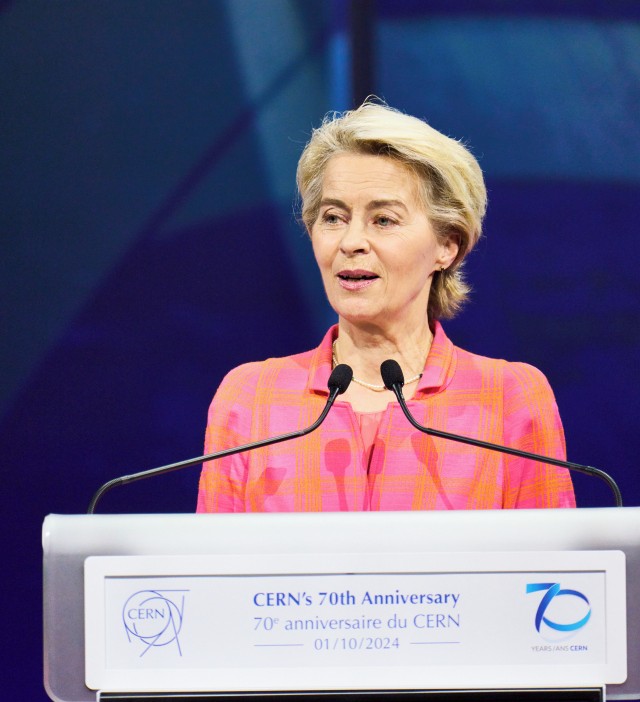
“We are in the midst of a global race for the technologies that will shape the world of tomorrow, from clean tech to quantum, from AI to fusion […] Your core mission at CERN has always been fundamental research. But all along your history, you have produced countless positive spillovers for our society and economy… You are constantly working with European industries, to build low-emission aeroplanes or to create new solutions to transport liquid hydrogen […] We need more of these partnerships between research and business; more ideas that go from the laboratory to the factory.“
Ursula Von der Leyen, President of the European Commission, CERN’s 70th anniversary official ceremony