

Management Approach
ENVIRONMENTAL STRATEGY AT CERN
CERN is deeply committed to environmental stewardship, which is integral to its operations and organisational goals. In alignment with the European Strategy for Particle Physics, which was last revised in 2020 and will be updated again in 2026, CERN adopts a systematic and unified approach to managing its environmental impact. The Strategy underscores the necessity for thorough examination and reduction of the environmental footprint of ongoing and future facilities.
CERN’s environmental and sustainability strategy is founded on three primary principles: minimising the Laboratory’s impact on the environment, minimising energy consumption while enhancing energy efficiency and reuse, and fostering the development of technologies that could contribute to mitigating the impact of society on the environment. The Occupational Health and Safety and Environmental Protection unit (HSE) acts as the principal authority on safety-related issues and monitors the implementation of the Organization’s safety policy, which integrates all health, safety and environmental aspects.
CERN adheres to the precautionary principle in all its environmental management efforts, taking proactive measures to avert significant environmental harm. This principle is universally applicable: in instances where available data does not allow a comprehensive risk assessment, precautionary actions are implemented without exception.
A STRUCTURED FRAMEWORK FOR ENVIRONMENTAL MANAGEMENT
CERN established the CERN Environmental Protection Steering board (CEPS) in 2017. CEPS is responsible for identifying and prioritising key environmental areas in alignment with CERN’s strategy and proposing specific action plans. Environmental objectives are approved by the Enlarged Directorate, which comprises all Directors and Department Heads. Following approval, CEPS oversees the execution of these objectives, which are periodically reviewed to address evolving priorities.
CERN’s Energy Management Panel (EMP), created in 2015 and comprising all the main energy consumers and stakeholders, complements these efforts by focusing on energy consumption reduction, efficiency improvements and energy reuse initiatives. The EMP was further strengthened in 2023 by the creation of the enlarged EMP, which specifically oversees the provisions of the ISO 50001 certification obtained by CERN on 2 February 2023. As the main internationally recognised energy management standard, ISO 50001 sets out processes to continuously improve energy performance. CERN follows these processes by setting up, monitoring and further developing an energy management system that is aligned with its energy policy and relevant legislation (see Energy).
Further, with a view to fostering the sustainability of its operations and future projects, the Sustainable Accelerator Panel (SAP) was set up in 2023 to liaise with future accelerator initiatives and develop full lifecycle sustainability as a key consideration in any project’s inception phase. The SAP also serves to identify accelerator technologies with the potential to reduce the environmental impact of future accelerators and collaborates with key partners, acting as a forum and focal point for exchange and discussion.
CERN’s environmental management approach includes an array of dedicated tools developed by the Organization, all of which support CERN’s commitment to environmental compliance and monitoring (See Environmental Compliance and Management of Hazardous Substances).
COLLABORATION WITH THE HOST STATES
As CERN operates on both French and Swiss territory, it collaborates closely with its two Host States, adopting regulations that are aligned with those of France and Switzerland. In cases where CERN has no specific regulation, national laws and regulations apply on a territorial basis.
In 2007, CERN formalised its collaboration with the Canton of Geneva and the Prefecture of Ain through a tripartite committee on non-radiological environmental matters (Comité Tripartite pour l’Environnement – CTE). This committee holds regular meetings to coordinate environmental issues. Additionally, in 2010, CERN signed a tripartite agreement on radiation protection and radiation safety with the Swiss Federal Office of Public Health (FOPH) and the French Nuclear Safety Authority (ASNR, formerly ASN), which provides a legal framework for radiation-related matters and fosters ongoing cooperation and reporting between CERN and these authorities.
FUNDING SCHEMES FOR ENVIRONMENTAL INITIATIVES
CERN continually updates its environmental strategy, identifying high-priority projects across several environmental domains. These initiatives have been allocated a budget of some 66 MCHF for the years 2019 to 2024. Projects include heat recovery systems, building consolidation, R&D on environmentally friendly gases and gas systems for detectors, and the construction of water retention basins.
In addition, CERN’s Knowledge Transfer (KT) fund, launched in 2011 to bridge the gap between research and industry, supports projects that apply CERN’s technologies for the benefit of the environment. The fund has allocated 1 MCHF to the projects of the CERN Innovation Programme on Environmental Applications (CIPEA) since the Programme was launched in 2022 (see Knowledge and Technology for the Environment). This sum is complemented by a nearly equivalent amount directly contributed by the various departments to support these projects. Between them, these internal contributions represent some 20% of the total equivalent budget supporting the programme, with the remaining 80% provided by the external commercial and institutional partners, either in cash or in kind.
SUSTAINABLE PROCUREMENT AND SUPPLY CHAIN
CERN’s commitment to environmental responsibility extends to its procurement processes. As an intergovernmental organisation, CERN shapes its own procurement rules, prioritising competitive tendering and balanced returns for its Member and Associate Member States. In June 2023, the Organization adopted the CERN Environmentally Responsible Procurement Policy, committing CERN to achieve sustainable results both internally and throughout its supply chains, integrating relevant best practices in its processes, measuring their impact, and communicating with and raising the awareness of all stakeholders. The Policy, approved by the Enlarged Directorate in June 2023, came into force on 1 January 2024 (See Procurement and Materials).
MATERIALITY AND REPORTING SCOPE
In 2022, CERN updated its materiality analysis to address topics deemed significant by both internal and external stakeholders, following the sustainability reporting standards of the Global Reporting Initiative (GRI), as well as addressing several CERN-specific issues. This analysis, whose results determined the focus areas of this report, also identified topics including soil health, non-ionising radiation and air quality as areas for future focus, while other topics such as effluent quality were identified as a lower priority but are still reported on for continuity and transparency.
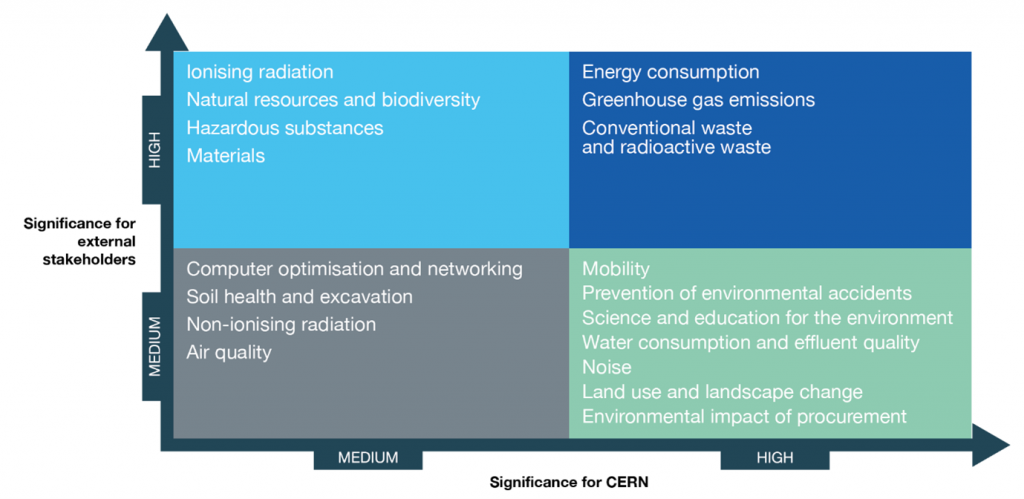
The topics identified as being of lower significance to all stakeholders are not comprehensively covered in this report but are subject to monitoring by CERN.
The data presented in this report reflects the impact of its facilities in the Geneva region, focusing exclusively on CERN-managed infrastructure. The production of equipment by collaborating institutes is excluded from the scope of the report. The Worldwide LHC Computing Grid (WLCG), while global, is included only where CERN facilities are directly involved.
In 1955, as an international organisation, CERN created its own social security system, including a pension scheme: the CERN Pension Fund. In 1968, CERN and the European Space Observatory (ESO) signed an agreement whereby ESO personnel joined the Fund. The purpose of the Fund is to insure its members and beneficiaries and members of their families against the economic consequences of disability, old age and death. In November 2021, the Pension Fund Governing Board (PFGB) adopted an Environmental, Social and Governance (ESG) policy as an integral part of the Fund’s Statement of Investment Principles. At the same time, the PFGB approved an ESG implementation work plan, with an explicit focus on addressing climate-related risks and opportunities. The results are reported yearly as an integral part of the Fund’s annual report and, given the distinct context, approach and framework, are not included in the scope of this report.
INTRODUCING ENVIRONMENTAL OBJECTIVES FOR THE PERIOD UNTIL 2030
CERN’s first environmental objectives covering the years 2020 until 2025, the anticipated end of Run 3, were defined by the CEPS in 2019 and approved by the Organization’s Enlarged Directorate in early 2020. In 2024, a revised schedule for the operation and shutdown of the accelerator complex was approved, delaying the end of Run 3 and the start of the third long shutdown to mid-2026. While this report provides an update on progress with respect to these original objectives, environmental objectives covering the period until 2030 have been developed and discussed by the CEPS as part of a participative and iterative process. These objectives were formally presented to and approved by the Enlarged Directorate in January 2024 and are set out in the relevant chapters of this report, where applicable.