
NOISE
CERN’s infrastructure is very diverse, with installations and specific equipment that produce varying levels of noise across its sites. The Organization manages its noise footprint through a noise monitoring programme, planning processes for new projects and the implementation of mitigation measures when needed, in accordance with CERN’s noise reduction policy.
MANAGING CERN’S NOISE FOOTPRINT
CERN’s noise reduction policy, published in 2019 and agreed with the Host State authorities, is effective and is subject to regular review. This policy commits the Organization to not exceed the reference noise levels at its perimeters by more than 3 dBA. The reference levels are based on measurements carried out in 2018 when all the accelerators were running (reference operation year).
As part of its noise management strategy, CERN carries out yearly noise measurement campaigns at 70 locations, both during the day and at night, to verify that the noise levels remain within the set limits and are compliant with the Host State regulations. The average noise levels measured at CERN’s site perimeters are typically 50 dBA during the day and 45 dBA at night. Noise measurement reports are provided to the local authorities and presented to the tripartite committee for the environment (See Management Approach).
CERN’s neighbouring environment is constantly evolving, with the construction of new residential buildings close to some of its installations. CERN collaborates with the municipalities in which its sites are located and liaises with them on plans for new residential areas and its own future projects. This liaison includes submitting noise impact assessments to the local authorities for any new significant project at the same time as the application for a construction permit.
CERN’s accelerator complex was in operation throughout the reporting period, and noise was generally kept within the 2018 reference levels. However, some cases of exceedance were reported in three specific locations, which were duly addressed using noise modelling predictions to design corrective actions. These actions are supported by 24/7 noise monitoring in the locations concerned, which allows measures to be taken based on real-time measurements.
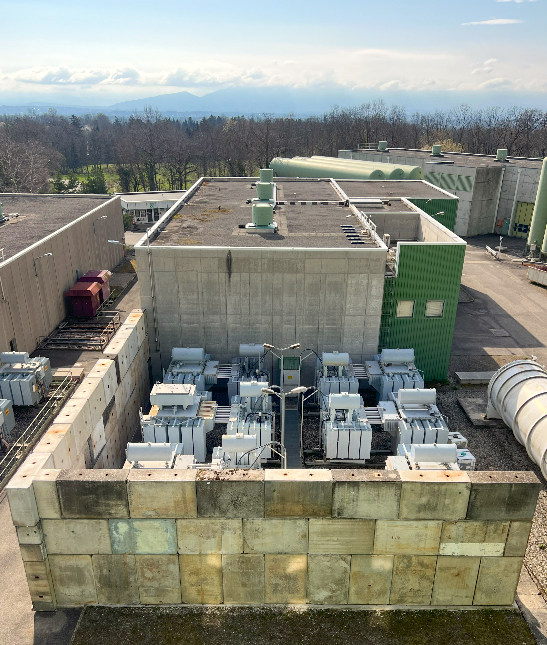
Over the reporting period, four claims were received, three associated with the noise produced by electrical equipment and a fourth concerning noise produced by cooling equipment due to high outdoor temperatures. The first three claims were addressed by installing shielding blocks (see ‘In Focus’). For the other claim, a solution to replace the cooling equipment during the next Long Shutdown is under investigation.
THE NOISE MONITORING PROGRAMME
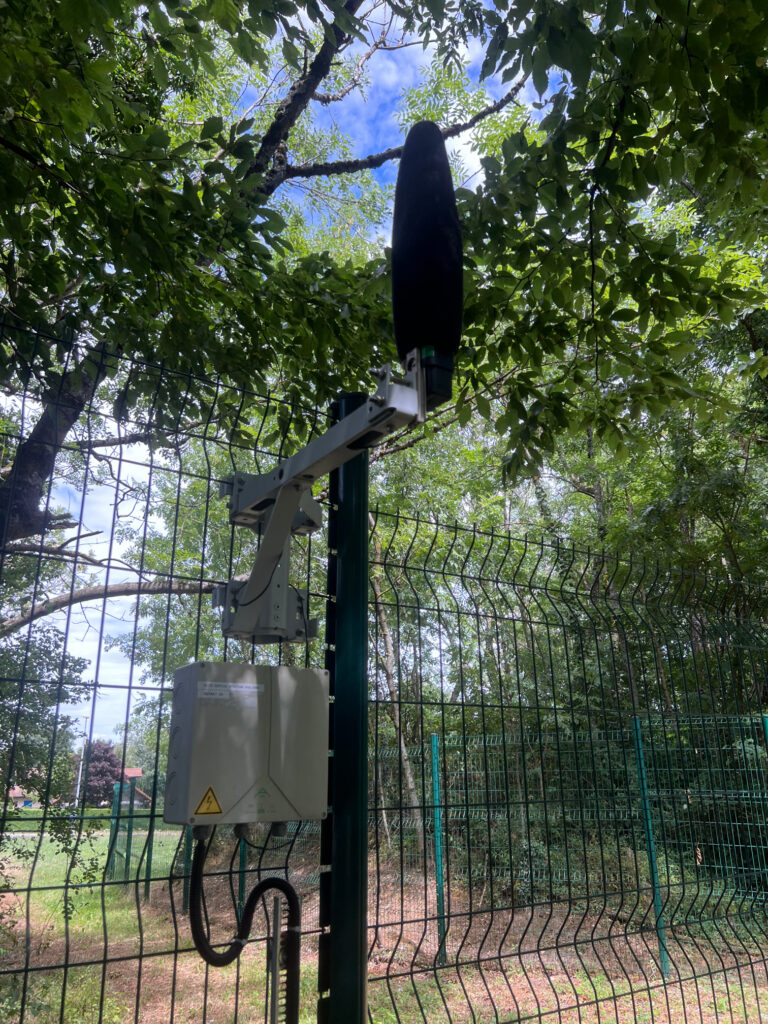
In the reporting period, to further optimise noise management across the CERN sites, the Organization took the decision to develop a new noise monitoring tool to be integrated into its environmental monitoring framework. The objective is to deploy permanent acoustic monitoring points, featuring real-time data integration with the Radiation and Environment Monitoring Unified Supervision (REMUS) platform, to allow sound level analysis and exceedance alerts.
GOALS FOR 2030
CERN’s priority is to control and reduce the noise footprint resulting from its activities. Concretely, over the period until 2030, CERN intends to reduce noise hotspots (>40 dBA) in residential areas, by means of systematic environmental noise impact assessments for new infrastructures and major consolidation work. In addition, CERN will continue to monitor the evolution of residential areas next to its sites, keeping the noise footprint maps and the 3D noise models up to date.
In focus
Jordan Minier is an acoustics engineer in the Environmental Prevention section of the Environment group.
— Can you tell us about how claims regarding noise levels are handled?
JM: When we receive a claim about noise or detect a case of exceedance during our measurement campaigns, we follow a structured process. It begins with a thorough site inspection to identify the noise source. Using data taken during machine operation, we correlate high noise levels with the operating conditions of specific equipment. Next, we characterise the acoustic emissions of the source and design tailored mitigation measures to ensure a long-lasting solution. These measures are developed and implemented collaboratively with the equipment owner so as to minimise noise while preserving the equipment’s operational performance. Their ultimate implementation also depends on the operation and shutdown schedules of the accelerators.
— What kind of situations do you encounter and what solutions are typically effective?
JM: Noise can come from various sources, such as ventilation systems, cooling equipment and electrical devices. Effective solutions often involve using acoustic silencers or screens to mitigate the propagation of sound in the environment. In some situations, we deploy concrete blocks, which are primarily designed for radiation protection but have also proven to be effective noise barriers. For example, when dealing with noise generated by electrical transformers, we use concrete blocks to create a barrier, avoiding the need for extensive and dangerous digging around the high-voltage transformers.
— What are the final stages in managing a claim?
JM: We perform compliance tests to ensure that we have achieved the required noise levels. If the results are unsatisfactory, we repeat the site inspection and run through the steps needed to ensure that a suitable solution is promptly found. If the noise levels are compliant, we implement preventive actions, including 24/7 noise measurements with alert systems, and issue monthly internal reports for our monitoring and follow-up purposes.